

The Real Reason Hair Straighteners and Dryers Won’t Cure a Lice Infestation

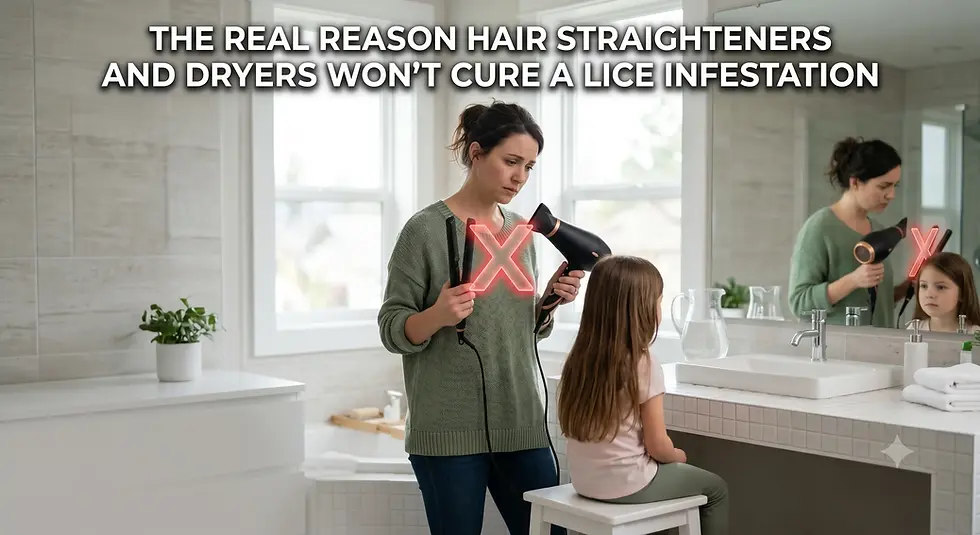
Many parents facing a lice discovery instinctively reach for the most powerful tool within arm's reach, and a 400°F flat iron or a high-heat blow dryer feels like exactly that. The logic seems sound: heat kills bacteria, heat sanitizes surfaces, so can heat kill lice? The answer is yes, but with a critical caveat that changes everything. Heat only eliminates lice under very specific conditions of temperature, exposure time, and physical proximity conditions that household styling tools are fundamentally unable to meet. Understanding why that gap exists, and where it leaves families who try these shortcuts, is what this article is designed to explain.
The Science of Heat: Why 130°F is the Magic Number for Lice
Discovering lice at midnight on the eve of a school picture day triggers a very specific kind of desperation. Parents reach for whatever seems most powerful within arm's reach, and a 400°F flat iron feels like exactly that. But before grabbing any styling tool, understanding the actual biology of a louse changes everything.
Lice die through rapid dehydration, not burning. These insects are primarily composed of water, and according to NIH research, heat kills lice by desiccating both the live bug and the protein-based glue that anchors nits to the hair shaft. So the question of whether heat can kill lice has a straightforward answer: yes, but only under very specific conditions.
The critical threshold is 130°F (54.4°C). Research from DerLICE® confirms this is the minimum temperature required to inhibit egg hatching and kill active lice. Equally important is exposure time; consistent heat must be maintained for 5 to 10 minutes to achieve a total kill. A quick pass delivers heat; it doesn't deliver results.
That gap between "enough heat to matter" and "heat applied correctly" is exactly where home remedies fall apart. The styling tools already sitting in your bathroom feel like a logical shortcut, but as the next section explores, the physics of temperature required to kill lice and the anatomy of where lice actually live create a fundamental conflict.
The Flat Iron Fallacy: Why Straighteners Miss the Target
Does straightening hair kill head lice? Technically, yes, but only the lice you can actually reach, which is the critical problem.
The temperature gap is real. Flat irons operate between 300°F and 450°F, far exceeding the 130°F threshold needed to kill lice on contact. On paper, that sounds like a solution. In practice, it exposes a structural flaw that makes straighteners nearly useless as a treatment tool.
The "Scalp Gap" is the core obstacle. According to Lice Clinics of America, lice live and lay eggs within 1/4 inch of the scalp, staying as close to the skin as possible for warmth and access to blood. A flat iron plate cannot physically touch that zone without pressing directly onto the skin. Even careful, experienced users cannot maneuver a straightener close enough without causing second-degree burns. That 1/4-inch gap is exactly where the infestation lives and exactly where the tool cannot go.
The nits further down the hair shaft are a red herring. When you do run a flat iron over the mid-shaft or ends of hair, you may encounter nits, but they're likely already empty casings or non-viable eggs. The temperature required to kill lice eggs only matters if you can reach viable ones, and those are anchored at the root, not scattered along the length.
⚠️ Safety Warning: Attempting to close the scalp gap by pressing a flat iron closer to the skin significantly increases the risk of contact burns. Second-degree burns from styling tools can cause blistering, scarring, and secondary infection, a serious outcome for a problem that has proven, safer solutions. Specialized lice removal services eliminate this risk entirely.
The flat iron feels decisive in a panicked moment, but it's solving the wrong problem in the wrong location. And the tool many parents reach for next to the blow dryer comes with its own set of complications worth careful understanding.
Blow Dryers vs. Medical Dehydration: A Dangerous Difference
Standard household blow dryers don't just fail to eliminate lice; they can actively make the situation worse by scattering live insects across surfaces and onto other family members.
High-velocity airflow is one of the most counterproductive head lice prevention tips. When lice sense a blast of fast-moving air, they trigger what researchers describe as a "hunker down" reflex, gripping hair shafts more tightly and flattening against the scalp. The very thing parents reach for in a panic is the same thing that sends lice migrating to pillowcases, brushes, and nearby siblings.
The contrast with medical-grade devices is stark. According to Healthline, standard handheld dryers are generally ineffective and can scatter lice, while specialized medical dryers achieve nearly 100% success rates. Devices like the AirAllé work on a fundamentally different principle: high-volume, low-velocity heated air that envelops the hair and dehydrates lice and nits without blowing them anywhere. The heat penetrates evenly; the lice have nowhere to run.
Cranking up the temperature on a home dryer to compensate typically leads to scalp burns before it leads to a cure. The physics simply don't translate from clinical equipment to bathroom appliances.
Home Blow Dryer | Medical Heat Device |
High-velocity, scattered airflow | Low-velocity, controlled airflow |
Displaces lice onto surfaces | Dehydrates lice in place |
Uneven heat distribution | Consistent, targeted heat delivery |
Risk of scalp injury at higher temps | Clinically calibrated temperature |
No documented cure rate | ~100% efficacy in clinical settings |
This is precisely why professional lice removal services use purpose-built technology rather than amplified versions of household tools. The good news is that effective heat is a treatment strategy; it just needs to be applied in the right place. That's where your home environment becomes the real battleground.
Where Heat Actually Works: Managing Your CT Home Environment
While questions like "does a flat iron kill lice effectively" or "can heat from a hair dryer kill lice" dominate the conversation, the real heat success story happens away from the bathroom mirror entirely in your laundry room.
The clothes dryer is the single most effective heat tool available to parents dealing with a lice infestation. Unlike a flat iron pressed against hair strands, a dryer creates a sustained, even heat environment that lice and nits simply cannot survive. According to DerLICE®'s internal protocol, placing bedding, hats, and clothing in a dryer on high heat for 30 minutes is 100% effective at killing any hitchhiking lice, with no guesswork and no missed scalp areas.
This environmental approach matters because lice don't only live on heads. They can survive briefly on pillowcases, hoodie liners, and stuffed animals, creating a cycle of re-infestation even after a successful treatment.
Environmental Heat Protocol:
Dryer (high heat, 30 minutes): Bedding, pillowcases, hats, scarves, stuffed animals, and any clothing worn in the past 48 hours.
Boiling water (130°F+, 10 minutes): Combs, hair ties, barrettes, and any hard plastic hair accessories.
Sealed plastic bag (2 weeks): Items that can't be washed or heated should be isolated until any surviving lice die off naturally.
Focusing this deliberate heat strategy on the home environment significantly reduces the risk of your child being reinfested days after treatment. It's a step many families skip, and it's often the reason a lice problem keeps coming back. Understanding where heat genuinely helps sets the foundation for recognizing where it falls dangerously short, which is a pattern worth examining more closely.
The Risks of DIY Heat: Beyond the Burn
DIY heat treatments create a dangerous illusion of success, allowing a full lice infestation to thrive while parents believe the problem is solved.
The "false negative" is the most costly mistake families make. A flat iron might singe a visible louse on a strand of hair, which feels like progress. But as the previous sections established, the scalp zone that is the critical quarter-inch closest to the skin remains untouched. The colony survives, eggs keep hatching, and the infestation continues undetected until it's significantly worse.
The super lice reality in Connecticut adds another layer of frustration. A large percentage of lice populations across the northeastern U.S. have developed resistance to permethrin-based treatments, which is exactly why so many parents pivot to heat as an alternative. The logic is understandable: if chemicals aren't working, maybe a blow dryer will kill lice at the root. But as the Lice Removal Network notes, to actually kill lice with a home dryer, you would likely have to keep the heat on one spot long enough to burn the scalp, an impossible and dangerous standard.
The emotional toll of repeated failed treatments is real. Families spend weekends combing, re-treating, and washing everything in the house only to discover live bugs again by Wednesday. That cycle of hope and disappointment, repeated week after week, is genuinely exhausting. Recognizing why these methods fail is the first step toward understanding what actually works, which brings up the bigger question of what a truly effective approach looks like.
The Bottom Line: What You Need to Know About Heat and Lice
Does heat kill lice and nits? Yes, but household styling tools are not medical solutions, and that distinction can cost families weeks of failed treatment.
The core problem is geography. Flat irons cannot reach the 1/4-inch scalp zone where lice and nits actually live. A straightener gliding down a hair strand may scorch what's visible, but the insects clinging closest to the scalp and the eggs cemented to the hair shaft at the root survive untouched. As licenders.com notes, the physics simply don't work in a parent's favor here.
Blow dryers introduce a different problem: high airflow can physically scatter live lice from the treated person's hair onto nearby family members, bedding, or clothing. What starts as one child's infestation can become a household-wide crisis, all because of a tool that felt like a reasonable solution.
The only method that carries a 100% satisfaction guarantee is professional manual removal combined with targeted environmental heat running infested items through a dryer at high heat, washing linens in hot water, and having a certified technician perform the systematic, strand-by-strand combing that no styling appliance can replicate. DerLICE® Service Standards back this guarantee because the process is thorough by design, not by chance.
Heat works. Styling tools don't, and knowing the difference is what gets families lice-free for good. If you're ready to skip the guesswork, the next section explains exactly how professional in-home care makes that possible.
Why Fairfield County Families Choose Professional In-Home Care
Busy families in New Haven and Fairfield County don't need a heat experiment; they need a solution that actually works, the first time. While the instinct to reach for a flat iron is understandable, the evidence is clear that a hair straightener kills lice, a claim that only holds up under conditions no parent can safely replicate at home. The scalp exposure, the missed nits, the re-infestation cycle, these are risks that a certified technician simply eliminates.
Professional, mobile lice care removes the guesswork entirely. DerLICE® brings discreet, in-home service directly to families across the region, with no waiting rooms, no scheduling chaos, and no exposure to other children in a clinical setting. For parents juggling school pickups, work schedules, and activities, that convenience isn't a luxury; it's the difference between a problem that gets resolved and one that drags on for weeks.
The treatment approach matters just as much as the convenience. Plant-based, non-toxic solutions protect children's scalps in a way that high-heat styling tools never can. And no tool replaces the trained eye and methodical manual combing of a certified technician, who clears every life stage egg, nymph, and adult with precision heat treatments can't match. DerLICE® backs that thoroughness with a four-week guarantee, so families can move forward with real confidence.
You don't have to risk a burned scalp to live lice-free. Book a DerLICE® in-home appointment today and let a certified technician handle what styling tools were never designed to do.


Comments