

Does Chlorine Kill Lice? What Pool Water Does and Doesn't Do


Does chlorine kill lice? No. The CDC says the chlorine levels used in pools, hot tubs and splash pads do not kill head lice. A swim will not treat lice, and it will not give them to your child either. This guide covers what pool water does, when to swim after treatment, and what to do instead. Every fact comes from the CDC, a peer-reviewed pool study, or a medicine label.
Written by the DerLICE team. Last updated November 20, 2026. Sources are listed at the end.
Does chlorine kill lice?
No. The CDC says chlorine levels used at pools, hot tubs and splash pads do not kill head lice. Healthline reports a lab test where lice sat in chlorinated water for 20 minutes. They stopped moving for a short time, then fully recovered in under a minute once they were out of the water.
So a pool day cannot replace lice medicine. If your child has lice, the pool will not clear them.
Can lice survive in a swimming pool?
Yes. So does chlorine kill lice if they stay under long enough? Still no. The CDC says head lice can survive under water for several hours. They hold tight to the hair and do not let go when a head goes under.
A 2007 study in the International Journal of Dermatology tested this in a lab and at a real pool. The lice survived being under water and fed normally afterward.
How long can lice live in a swimming pool?
Under water, several hours, according to the CDC. That is much longer than any swim lesson or lap session.
Off a person, the clock is short. The California Department of Public Health says adult lice die within one to two days away from the head. The CDC says it would be rare to find lice floating in pool water, because they stay on the hair. For the full timeline by stage, read our guide on how long head lice live off the host.
Does chlorine kill nits?
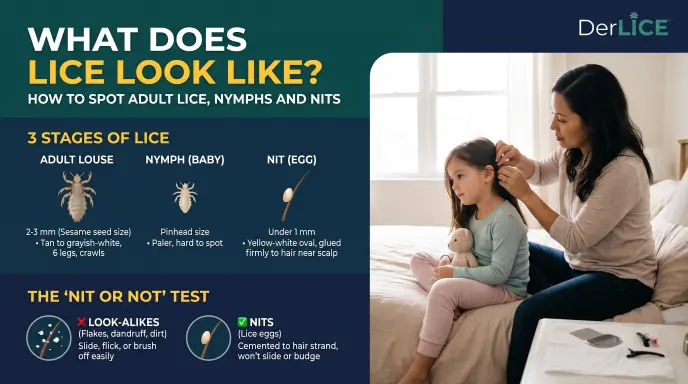
Parents often follow up with a second question: does chlorine kill lice eggs too? No source we checked says it does. Nits are eggs glued to the hair shaft near the scalp. Nothing we found shows pool water loosens that glue.
Even lice medicine has limits here. The CDC says permethrin (the active ingredient in Nix) kills live lice but not unhatched eggs. That is why combing and rechecking the hair matter. Our nit removal service takes out nits by hand.
Can you get lice from a swimming pool?
It is unlikely. The CDC says head lice are unlikely to move through pool, hot tub or splash pad water. Lice crawl. They cannot hop or fly.
In the 2007 study, four people with lice swam for 30 minutes. No lice came off, and none moved to other swimmers. The main route is still head-to-head contact, and that can happen at a pool the same way it can happen at school.
Which pool-day items can pass lice?
Items that touch a head. The CDC and Healthline both name towels used to dry hair, hats, combs and brushes. Before you leave for the pool, pack:
One towel per child, and a separate one for hair.
Each child's own brush or comb.
Each child's own hat or swim cap.
Hair ties that stay in the bag.
Teach kids not to borrow these at poolside or in the changing room. Hang wet towels apart from other families' towels, and bag them separately on the way home.
Can lice drown?
Not in a pool. Lice stay under water for several hours and hold the hair the whole time. Waiting for a swim to drown them only gives them more time on the scalp. Use a lice medicine as the label says.
Does a hot tub, saltwater or the ocean kill lice?
A hot tub does not. Does chlorine kill lice in a hot tub? The CDC's answer is the same as for pools. It puts hot tubs and splash pads in the same group as pools: chlorine there does not kill head lice.
For salt water and the ocean, we found no health agency page that says either one kills lice. Do not count a beach day as treatment. Connecticut families swim at places like Hammonasset Beach in Madison, Sherwood Island in Westport and Lighthouse Point in New Haven. Enjoy them, and keep treating lice the usual way.
Water or product | Does it kill lice? | What the source says |
Pool chlorine | No | CDC: chlorine levels at pools do not kill head lice |
Hot tub or splash pad | No | CDC: same as pools |
Salt water or ocean | No source found | No agency page found that says it works |
Strong chlorine or bleach on the scalp | No, and it can burn | Healthline: burns and blisters |
Lice medicine, used as labeled | Yes, for live lice | CDC: some medicines also kill eggs |
Does chlorine kill sea lice?
Sea lice are not head lice, so lice medicine is not the answer. WebMD says "sea lice" is the common name for a rash called seabather's eruption. It comes from jellyfish and sea anemone larvae, and it has no link to head lice.
Healthline says the larvae get trapped under swimsuits and in hair, and the rash usually lasts two to four days. Cleveland Clinic says reports are most common in Florida and the Caribbean. We found no source on chlorine and sea lice. If your child has an itchy rash after the ocean, check the scalp for live lice before you treat, and ask a doctor about the rash.
Can you go swimming if you have head lice, and when after treatment?
The CDC says water is an unlikely way to pass lice. Camps and town pools can still set their own rules, so ask before you go. Share nothing from your child's bag, and keep wet hair away from other swimmers' heads at the edge of the swimming pool.
After treatment, timing matters. The CDC says do not swim or wash your hair within one to two days of treating with anti-lice shampoo. A simple plan:
Treat as the medicine label says.
Wait one to two days before swimming, or longer if your label says so.
Check and comb every two to three days for two to three weeks. This is the CDC's schedule.
Treat again only as the label directs.
Can you swim after Nix or ivermectin lice treatment?
Follow the label on your product.
For Nix, the CDC archive and Cleveland Clinic both say not to re-wash the hair for one to two days after use. Healthline adds that Nix may not work as well if pool chlorine touches the hair.
For ivermectin lotion (Sklice), the label says to rinse with water only after 10 minutes and to wait 24 hours before shampoo. The label text we found does not mention swimming. Ask your pharmacist, and use the CDC's one to two day wait as the safe rule.
Will chlorine make lice treatment work less well?
Swimming soon after treatment can. The CDC says swimming or washing the hair within one to two days of anti-lice shampoo makes treatment less effective. Iowa's health department says the same about some medicines.
Does chlorine kill lice, or does it only get in the way of treatment? It only gets in the way of the medicine. The fix is timing, not chemistry. Keep the hair out of the pool until your label says it is safe.
Is it safe to put bleach or strong chlorine on the scalp?
No. Does chlorine kill lice at a higher strength? Healthline says a stronger chlorine mix will not kill lice. It can cause burns and blisters, eye damage and breathing trouble. UPMC says bleach can irritate skin, and at higher strength it can cause a chemical burn.
If bleach touches skin, rinse with cool running water for at least 15 minutes. Call Poison Control at 1-800-222-1222 if you have any doubt. Lightener is a different product, and we cover it in does hair dye kill lice.
What kills lice fast?
Lice medicine used exactly as the label says. The CDC says both over-the-counter and prescription medicines can treat lice, and some also kill eggs. The American Academy of Pediatrics notes that some over-the-counter products can fail where lice have grown resistant.
After treatment, comb the hair and check again every two to three days. If live lice remain, treat again only as directed. Our in-home lice removal clears lice and nits at home, with no medicine guesswork.
Can Coca-Cola, smells or home remedies kill lice?
We found no proof that cola or a strong smell gets rid of lice. The CDC says there is no clear evidence that mayonnaise or olive oil work. Healthline says the American Academy of Pediatrics reports no studies showing home remedies clear head lice.
Skip the pantry. The question was never whether a kitchen item can do what chlorine cannot. It is which treatment has real evidence behind it, and that is a medicine or a trained technician.
When should you call a lice professional in Connecticut?
Call when the medicine did not work, when the scalp is sore, or when more than one person at home has lice. A DerLICE technician comes to your door, so there is no trip to a clinic and no car ride on I-95 with a child who has wet hair. We work with families in towns like Westport, Milford, Danbury and Wallingford, and pool and camp season is when many of them call.
Not sure it is lice? Our lice screening checks the head first. Call (203) 572-1880.
So, does chlorine kill lice? No. Treat the lice, wait out the label time, then go swim.


Comments