

What Does Lice Look Like? How to Spot Adult Lice, Nymphs and Nits

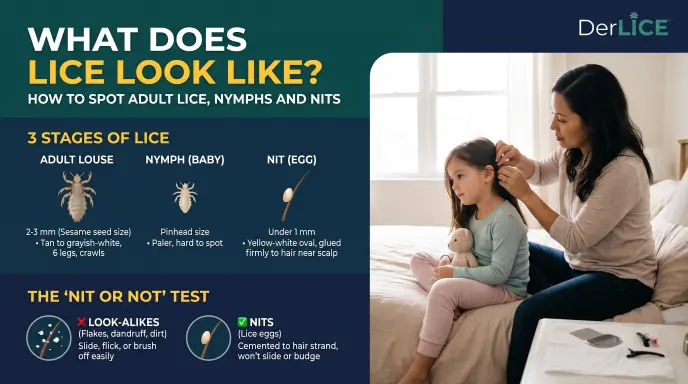
Quick answer: What does lice look like? An adult louse is tan to grayish-white, about the size of a sesame seed, with six legs. A nymph (baby louse) is pinhead size. Nits are tiny yellow-to-white ovals glued to the hair near the scalp. Lice crawl fast. Nits stay put when you try to brush them off.
You found a speck, a bug or an itchy spot, and you ask, "What does lice look like?" This guide shows you the size, color and shape of each stage, where they sit on the head, and what else can fool you. It is written for Connecticut parents and adults. One live louse is the only sure proof.
Written by the DerLICE team. Updated November 2026. Every size and rule below was checked against the CDC, Harvard Health and other sources listed at the end.
What does lice look like?
Head lice come in three forms: adult, nymph and nit. Adults are about as big as a sesame seed, six-legged and tan to grayish-white. Nymphs look like small adults. Nits are the eggs, glued to hair near the scalp. The table shows all three side by side.
Stage | Size | Color | Where you find it |
Adult louse | About 2 to 3 mm, a sesame seed | Tan to grayish-white; darker on dark hair | Scalp, behind the ears, back of the neck |
Nymph | About a pinhead | Paler, tan | Scalp |
Nit | Tiny oval, under 1 mm | Yellow, white, tan or brown | Glued to the hair, within about a quarter inch of the scalp |
What do adult lice look like?
An adult louse is wingless, flat and six-legged. The CDC says it is roughly 2 to 3 mm long, about the size of a sesame seed. Harvard Health adds that each leg ends in a hooklike claw that grips the hair. It is tan to grayish-white and can look darker on dark hair. Lice cannot hop or fly. They only crawl.
Do lice look black?
Not usually. Most adult lice are tan to grayish-white. On dark hair, they can look dark, and a CDC checking handout describes live lice as dark. Color changes with your hair, the light and the angle. So go by size, six legs and movement, not by color alone.
What do nymphs (baby lice) look like?
A nymph looks like a small adult. The CDC says it is about the size of a pinhead. It is paler, so it is harder to spot. Nymphs also feed on blood, so one nymph means an active case, not just leftover eggs.
What do nits look like?
Nits are tiny ovals, usually yellow or white, stuck firmly to the hair shaft close to the scalp. Many sources compare them to the knot in a thread. They are about 0.8 mm long. In this guide, "nit" means the egg. Do not confuse them with flakes, which slide off. Nits do not move when you flick them.
What does head lice and nits look like side by side?
Lice move and have legs. Nits do not move and look like tiny glued beads. The CDC says nits sit within about a quarter inch of the base of the hair. Nits more than a quarter inch from the scalp are almost always empty or dead. If you see crawling lice and nits near the scalp, you have an active case.
What does lice look like in hair, and where do they sit?
Look at the scalp, not the ends of the hair. The CDC says nits are often found on the hair behind the ears and near the back of the neck. Live lice hold the hair with their claws and move away from light. That is why a quick glance often misses them. Part the hair and look close to the skin. This is also what do lice look like in hair when you check: small, tan and fast near the roots.
What does head lice look like in dark hair and in light hair?
On dark hair, adults can look darker, and the CDC handout says nits can be easier to see than lice. On light or blonde hair, lice and nymphs can look pale and blend in, so what does lice look like on blonde hair? Pale and easy to miss. Nits can take on a color close to the hair. Bright light and a comb help on every hair color. For coils, braids and locs, see our guide on lice and textured hair.
Can you see lice with the naked eye?
So what does lice look like to the naked eye? Adults are big enough to see. But they crawl fast and hide from light, so many people miss them. Nymphs and nits are smaller. A bright lamp, a clear part and a magnifying lens help. The CDC says a magnifying lens may help you find crawling lice or nits.
What do lice and nits look like on a comb, a finger or a paper towel?
Wipe the comb on a white paper towel or a white cloth. Healthline says nits and nymphs often look tan to brown on white paper. A louse is a tiny bug that crawls. A nit is a tiny oval speck that does not move. On a finger, a nit stays glued to its hair, while flakes fall away.
What can be mistaken for a nit?
Flakes, product buildup, hair spray droplets, scabs, sand and dirt can all look like nits. A hair cast can too. The test is simple. Nits are cemented to the hair. Most look-alikes slide, flick or brush off.
Looks like a nit | How to tell the difference |
Flakes or dry scalp | Slides or flicks off |
Hair spray or product droplets | Rubs or brushes off |
Hair cast (white tube around the strand) | Slides along the strand |
Scab | Sits on the skin, not on the hair |
Sand or dirt | Falls out or wipes off |
Nit | Glued to the strand and will not slide |
Medical News Today describes a hair cast as a thin white tube around the hair, about 2 to 8 mm long. Parents often chase hair casts for weeks, so check whether the speck moves along the strand.
What color are nits, and what does "nit" mean?
"Nit" means the egg. Some sites also use it for the empty shell. Healthline says live eggs look yellow, tan or dark brown, and empty shells look white or clear. The CDC says nits are often yellow to white. Color depends on stage and hair color, so color alone is not proof.
What if you find nits but no lice?
Look at the distance. Nits more than about a quarter inch from the scalp are almost always empty or dead, says the CDC. Nits closer to the scalp may be live. Check the whole head for crawling lice, then check again in a few days. If you are unsure, a trained checker can tell.
How do you check for lice and nits at home?
Sit in bright light, near a window or under a lamp.
Part the hair in small sections.
Start behind the ears, at the nape and at the crown.
Look for crawling lice and for glued nits near the scalp.
Comb each section with a fine-tooth lice comb and wipe the comb on a white towel.
The CDC says finding a live louse or nymph on the scalp or in the hair is the best way to diagnose lice. Our lice screening page explains a professional check.
Does wet hair make lice and nits easier to see?
For many people, yes. Harvard Health suggests a fine-tooth comb on wet hair, working in small sections, with a magnifying glass and bright light. Consumer Reports also describes wet combing. Wipe the comb on a white towel after each pass.
How can you tell lice from flakes or dry scalp when your head itches?
Itching alone does not prove lice. The CDC says it comes from an allergic reaction to louse bites. It can take four to six weeks to start the first time, and some people never itch. Only a live louse, or a nit stuck near the scalp, confirms lice.
Do lice look the same on every child?
What does lice look like on a child with thick hair? The same insect. How easy it is to see changes with hair color, thickness and texture. Thick or coily hair takes more patience. Work in small sections with good light. Anyone can get lice, and it has nothing to do with clean or dirty hair.
When should you call a lice professional in Connecticut?
Call when you are not sure what you see, when medicine did not work, or when combing at home is too much. A DerLICE technician comes to your home, from Bridgeport and Fairfield along I-95 to Westport, Milford, Wallingford and Danbury. Call (203) 572-1880 or read how in-home lice removal works.
The short version
What does lice look like? Adults are sesame-seed size and tan to grayish-white. Nymphs are pinhead size. Nits are tiny ovals glued near the scalp. Look behind the ears and at the nape in bright light. A live louse is the only sure proof.


Comments