

Can Black People Get Lice? What the CDC Says and How to Check Textured Hair


You may have heard that Black people do not get lice. That is not true. Can Black people get lice? Yes. The CDC says head lice are much less common among African American persons in the United States than among other groups. Less common does not mean never. This guide covers what the research says, what nobody has proven, and how to check coils, braids and locs. It is written for Connecticut families, from Bridgeport to Hartford.
Can Black people get lice?
Yes. Black people can get head lice. The CDC says infestation is much less common among African American persons in the US, but lice do not need a certain hair type. They need a scalp to feed on and head-to-head contact to move. That can happen to anyone. The CDC says lice are most common in preschool and elementary school children and the people they live with. Adults get them too. People often ask, can Black people have lice as adults? Yes.
Do Black people get head lice as often as other groups?
No. The CDC says infestation is much less common among African American persons than among persons of other races. That is the answer to the question "which race is least likely to get lice?" in the US. But lice do not choose by race. A New York City study, summarized in Hektoen International, found that 15 percent of 254 children diagnosed with head lice were Black. The review says other centers need to repeat that work.
What percent of Black people get lice?
No one knows an exact number. The CDC says it is much less common but gives no rate. One school study cited by Hektoen International found lice in 6.4 percent of 1,515 Hispanic, Asian and white children and in none of 436 Black children. That is one study, not a national rate. Some blogs quote "under 0.5 percent." We could not trace that to a primary source, so we leave it out.
Why are head lice less common in Black children?
The likely reason is the louse itself. The CDC says the head louse found most often in the US may have claws that grip some hair shapes and widths better than others. Nebraska's health department says this is possibly why infestation is less common in African Americans. So if you ask why don't Black people get lice as often, the answer is "possibly." Nobody has proven one single cause.
Can Black people get lice in their hair, or is that a myth?
Yes, they can, and the myth does harm. Lice live on the scalp and lay nits at the base of the hair shaft, close to the scalp, says Pennsylvania's health department. If a family thinks lice are impossible, nobody checks. Consumer Reports interviewed experts who say this belief can keep people from getting help. Lice are not a sign of dirty hair, and the AAP says they are not a health hazard.
Do hair oils, sheens or braids keep lice away?
No agency says so. We found no CDC or AAP guidance that lists oils, sheens, creams or braids as a way to prevent lice. Some lice clinics say they lower the risk but show no study. BlackDoctor.org notes that many patients who used styling products still got lice. A protective style does not stop heads from touching. Call this unproven.
Quick myth check
Common claim | What the sources say | Source |
Black people can't get lice | They can. It is much less common in the US. | CDC |
Textured hair is safe | No agency says so. Lice need a scalp. | CDC |
Oils or braids prevent lice | Unproven. No CDC or AAP guidance found. | Gap |
Wigs and weaves pass lice | Extremely unlikely if not worn by someone with lice in the past 48 hours. | CDC |
Relaxing hair kills lice | Not advised. Relaxers are not made for the scalp. | AAP |
Lice mean dirty hair | Lice are not related to cleanliness. | CDC |
Can curly hair get lice?
Yes. So can Black people get lice in curly or coily hair? Yes. The CDC does not say curly hair is safe. It says the claws "may" fit some hair better than others. That speaks to the odds, not a promise. Curly hair and lice still meet when heads touch. Any child with close head contact can get lice, whether the hair is curly, coily, wavy or straight.
Can mixed-race children get lice?
Yes. Hair type differs from child to child, so no one should assume a child is safe. No source we found says mixed hair type changes the risk. Lice need a scalp and head contact, not one hair shape. Check any child with an itchy scalp or a school notice.
What do lice in Black hair look like, and how do you check?
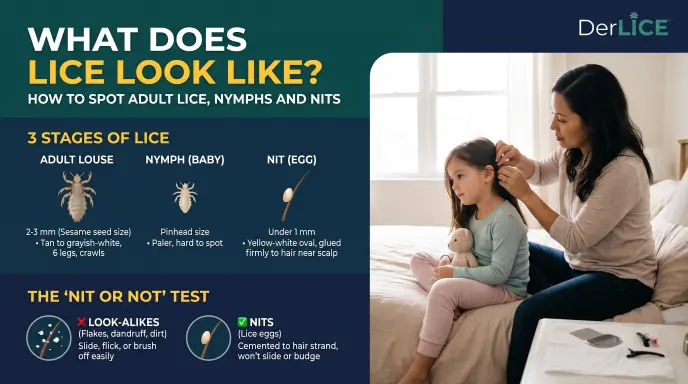
Look at the scalp first, not the ends of the hair. An adult louse is about the size of a sesame seed and may look darker in dark hair, says Pennsylvania's health department. Nits are tiny, oval and glued to the hair close to the scalp. Those within a quarter inch of the scalp are the ones that matter.
To check coily hair:
Sit in bright light, near a window or under a lamp.
Part the hair in small sections. Use clips to keep checked sections apart.
Start behind the ears, at the nape and at the crown.
Look for crawling lice and nits stuck to the hair. Lice crawl. They do not hop or fly.
Wet the hair and add conditioner. Comb each section with a nit comb. Consumer Reports lists this wet-combing method.
A fine-tooth comb can snag coils, so go slowly. Our lice check is a way to confirm what you see.
Is it lice or something else that itches?
Itching alone does not prove lice. The CDC says itching comes from an allergic reaction to louse bites. It can take four to six weeks to start the first time, and some people have no itch at all. Flakes and product buildup brush off. Nits stay put because they are cemented to the hair. Other scalp conditions, such as seborrheic dermatitis, also itch. Only a live louse confirms lice. A doctor can help if you cannot tell.
Can Black people get head lice from wigs, weaves or extensions?
It is very unlikely. The CDC says getting head lice from a wig or hairpiece is extremely unlikely, especially if it was not worn in the past 48 hours by a person with lice. The CDC also says that hats, scarves and hair ribbons worn by an infested person are an uncommon way to get lice. Head-to-head contact is the real risk.
Can Black people get lice at school, camp or sleepovers?
Yes. The CDC lists school, home, sports, playgrounds, camp and slumber parties as places where heads touch. Some studies suggest girls get lice more often than boys, probably because of more head contact. That includes Connecticut classrooms, summer camps and sleepovers. Getting lice has nothing to do with how clean a person or home is.
Is lice treatment safe for textured hair, and what kills lice?
Standard treatments are used on all hair types if you follow the label. The CDC says both over-the-counter and prescription medicines work. Some kill lice and eggs. Others do not, so you may need a second treatment. Permethrin (brand name Nix) is approved for children two months and older, but some lice resist it. The AAP says to call your pediatrician for a proper diagnosis and product.
Do not put conditioner on before the medicine. The California Department of Public Health says conditioner can keep the medicine from working. It also says not to wash the hair for one to two days after treatment and to check again seven to ten days later. Combing out nits takes more time in coils, so work in small sections.
Can Black people get lice with braids, locs or dreads, and do you have to take them out?
Lice can live on any scalp, so yes. No agency says you must take down braids or locs, or cut or straighten the hair, to treat lice. Some forum posts say relaxing or cutting hair "killed" lice. That is personal stories, not research. The AAP warns that chemical straighteners are not designed to touch the scalp and can cause chemical burns. Heat does not kill lice.
For braids, check the scalp between the rows. For locs, check where each loc meets the scalp. If you find live lice, ask a professional how to treat your style.
What attracts lice, and does any smell keep them away?
Head-to-head contact. Do Black people get lice for different reasons than anyone else? No. The CDC says getting lice is not related to how clean you or your home is. We found no CDC or AAP guidance saying a smell keeps lice away. A regular check works better than any scent.
When should you call a lice professional in Connecticut?
Call when you cannot tell if it is lice, when medicine did not work, or when combing coils at home is too hard. A DerLICE technician comes to your door in Bridgeport, Fairfield, Westport, Milford, Wallingford, Danbury and nearby towns. Call (203) 572-1880. See our in-home lice removal and nit removal pages. Related reading: how long lice live off the head, hair dye and chlorine.
The short version
Can Black people get lice? Yes, though less often in the US. The CDC says so, and families should still check. Oils, braids and hair type are not proven shields. Wigs are an unlikely source. Treatment follows the label, not the hair type.


Comments